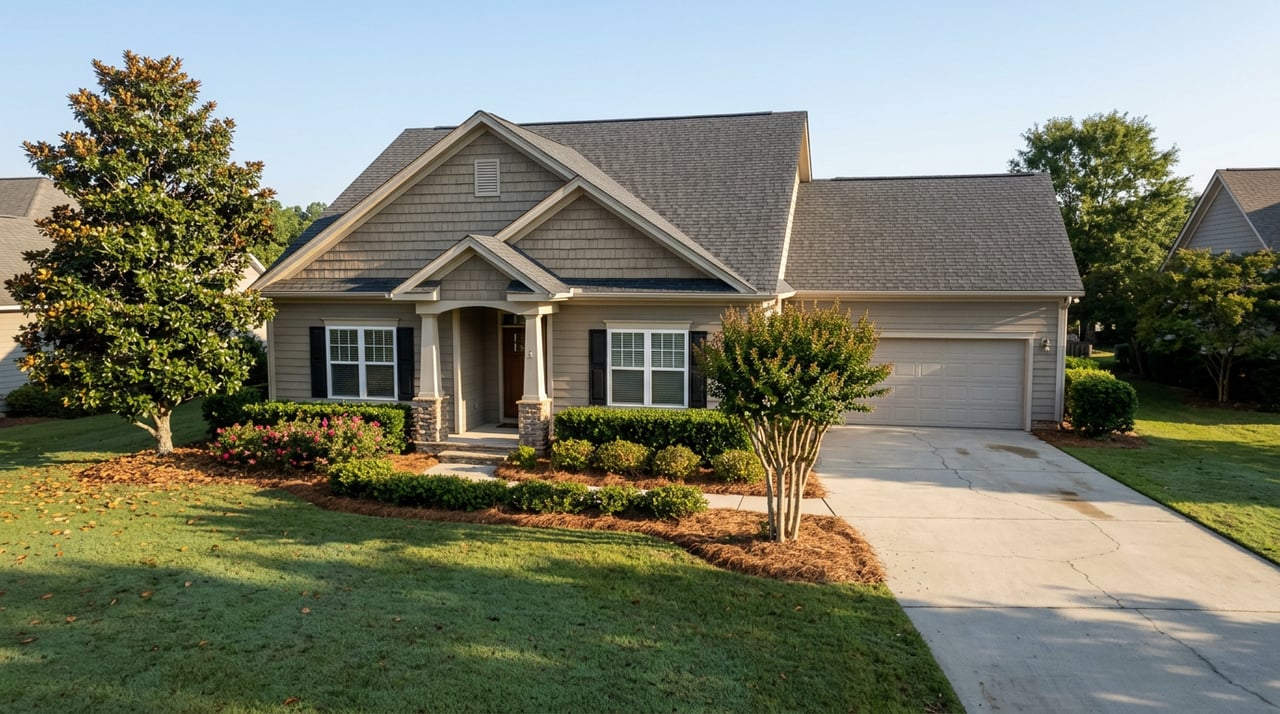
A buyer walking through a 1940s bungalow three blocks from Judson Mill this spring did what most buyers do when they hear a property just got annexed into the city: she assumed her tax bill was about to go up. City services usually cost something. Sidewalks, streetlights, city police coverage, all of that sounds like a line item.
According to the officials who ran the process, she had the direction backward. And whether you land on the right side of that assumption depends on which edge of Greenville your parcel sits on.
What Actually Got Annexed
In February 2026, Greenville's planning commission unanimously approved a request to annex and rezone about 41 acres that included Judson Mill and part of the surrounding Sterling neighborhood, with no one showing up to speak against it at the public hearing. By the time city council gave the ordinance its final reading, the footprint had grown to 48.6 acres across 22 individual parcels on Andrews Street, Bel Aire Drive, Easley Bridge Road, Fourth Street, Third Street, Lyncrest Street, Neubert Street, and several other named blocks around the mill.
The properties were split into two zoning categories. The mill site itself became Industrial Flex District, which allows residential units alongside commercial and light industrial uses. The residential parcels around it became Neighborhood A District, a designation built for lower-density, walkable blocks. For an annexation of this size to move forward, state process requires agreement from owners representing 75 percent of the parcels and 75 percent of the assessed value in the area. The city reported it had signatures from 83 percent of owners representing 99 percent of the land's value, which is why the vote drew no debate.
Resident Cameron Myers, who lives at Judson Mill, told a local news crew the change could mean access to city police and fire coverage that the area didn't have as unincorporated county land. Planning Commissioner Pamela Adams Singleton made a similar point about sidewalks and walkability once the city has jurisdiction to plan them.
Why This Particular Mill, Right Now
As the Greenville Journal reported, Judson Mill isn't an isolated deal. City staff have described a deliberate strategy: annex the old textile mills first, because they carry historical weight and because bringing them inside city limits opens the door to redevelopment financing that county land often can't access. Brandon Mill in west Greenville was annexed in the fall of 2025. American Spinning Mill followed in December 2025. Judson Mill's turn came a few months later.
The mill itself gives the strategy something to point to. Developers finished the $150 million redevelopment of the 800,000-square-foot complex in 2026, a project that had been underway for nearly a decade after the original textile operation closed in 2015. The finished campus includes Judson Mill Lofts and a second residential phase called the Jenny and Westervelt, along with a working mix of businesses on site: The Foundry, a live entertainment venue with a concert calendar running through 2026; a grocery concept called Feed and Seed; and Mill City Kitchen for dining. The project earned a 2025 Honor Award in Adaptive Reuse and Historic Preservation from AIA Greenville that December.
None of that history changes a tax rate on its own. What changes it is what happens after the annexation paperwork clears.
The Tax Direction Most Buyers Get Backward
Greenville City Councilmember John DeWorken has said he evaluates every annexation application by asking whether it brings value to current residents, not just new ones. A city staffer named Lavrin pointed to Judson Mill specifically as an example of how bringing a strategic property into city limits can unlock redevelopment that wouldn't otherwise happen.
Here's the part that surprises most buyers. City leaders have said annexations on the western edge of Greenville, where Judson Mill sits, tend to lower property taxes for the owners involved. On the east side of the city, the opposite happens: property owners there are less likely to pursue annexation because it tends to raise their tax bill. The Greenville Journal reported that a city official identified as White explained the pattern and the related effort to close "doughnut holes," pockets of unincorporated county land surrounded on all sides by city boundaries, which complicate everything from trash pickup to emergency response.
That directional pattern is not a guarantee for any single parcel. Millage rates, school district overlaps, and homestead exemptions still shape the final number on a specific tax bill. But if you're comparing a home near Judson Mill to one in a similar price range on Greenville's east side, the annexation math is not the same in both directions, and assuming otherwise is exactly the kind of mistake that shows up as a surprise at the first tax notice.
Reading Sterling's Price Jump Without Getting Fooled
Here is where the zoning and tax story connects to what buyers actually see first: the number on the listing.
Over the trailing 12 months, the median sale price for homes in Sterling reached $494,500, up 16 percent from the prior 12-month period. On its own, that looks like a neighborhood catching fire. The detail that tempers it: homes in Sterling took an average of 95 days to sell in that same window, nearly double the 50-day national average.
Compare that to the city as a whole. Over the three months ending June 2026, Greenville's citywide median sale price sat near $525,000, up a modest 0.3 percent year over year, with price per square foot climbing a sharper 13.5 percent and homes averaging 59 days on market, up from 47 a year earlier.
| Metric | Sterling (trailing 12 months) | Greenville citywide (3 months ending June 2026) |
|---|---|---|
| Median sale price | $494,500 | ~$525,000 |
| Year-over-year change | +16% | +0.3% |
| Days on market | 95 | 59 |
A fast-rising median paired with a slow-moving market is usually a sign of thin transaction volume, where a handful of renovated bungalows or new infill builds can swing the whole number. Citywide reporting has flagged the exact same pattern in nearby West Greenville, where a small sample produced a median jump alongside a falling price per square foot in the same period, a combination the reporting explicitly called directional rather than precise. Sterling's numbers deserve the same caution. A 16 percent jump built on a small number of sales tells you a redevelopment is drawing interest. It does not yet tell you what a typical home on a typical block is worth.
What This Means If You're Comparing Blocks
If you're weighing a home near Judson Mill against something in another part of Greenville, three things are worth checking before you assume the median tells the whole story.
- Confirm the parcel's current zoning and annexation status directly, since Neighborhood A zoning caps density in a way that protects the block's current scale, while the Industrial Flex zoning on the mill site itself allows for more commercial and light industrial use nearby.
- Ask what tax district the parcel falls into post-annexation, rather than assuming annexation moves the bill in one direction. The pattern city officials describe cuts differently depending on which side of Greenville you're standing on.
- Treat a fast-rising neighborhood median as a lead worth investigating, not a settled fact, especially in a pocket where total sales volume is still small enough that a few transactions can move the number.
Separately, the city has also been working through a broader update to its development code, including a new rule for other in-town residential zoning districts that requires new infill lots to be at least 70 percent as wide as the surrounding average, a response to concerns about aggressive subdivision in established neighborhoods. It's a sign of the city's general posture toward protecting older neighborhood scale even as it annexes and redevelops the mills around them.
A Few Quick Answers
Does annexation actually change day-to-day services like trash pickup or police response? Potentially. That's a benefit residents and city officials point to, and it's part of why the city has prioritized closing unincorporated pockets surrounded by its own boundaries.
Will other mills near Sterling get annexed next? Brandon Mill and American Spinning Mill were both annexed in the months before Judson Mill, and city staff have described the mills as a deliberate early target. More activity in this corridor would fit the pattern already established.
Is Sterling's 16 percent price jump a reliable signal for future appreciation? Treat it as a lead, not a conclusion. The 95-day average time on market suggests a small number of sales are doing the work, which is exactly the kind of pattern that can reverse or flatten once more inventory trades.
Should I expect a higher tax bill if I buy on Greenville's east side instead? Not necessarily for a specific parcel. Based on how city officials have described the pattern, annexations there have tended to raise property taxes rather than lower them, the reverse of what tends to happen on the western edge where Judson Mill sits.
If you're trying to figure out what a specific parcel near Judson Mill or anywhere else in Greenville actually means for your tax bill, your resale timeline, or the character of the block five years from now, that's exactly the kind of groundwork Brockelman Realty walks through before any offer goes in. Book a consultation and we'll pull the zoning, the annexation history, and the real comps for the specific address you're considering, not just the neighborhood median.
This article is general information, not legal, tax or financial advice. Consult a qualified professional about your situation.